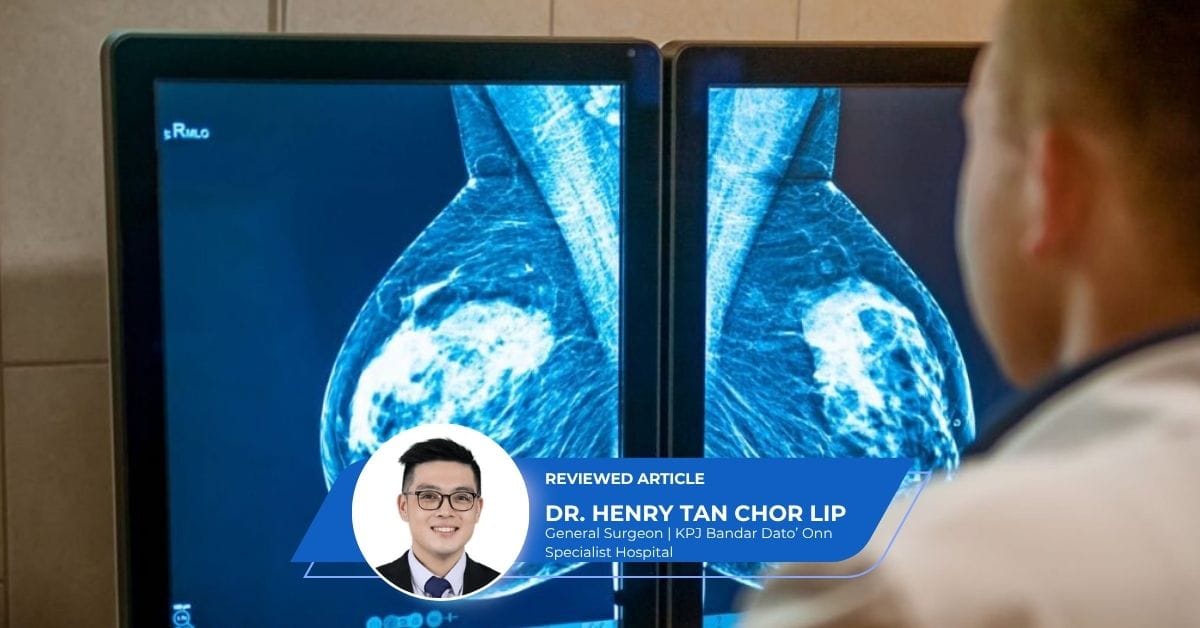
Breast Cancer, Malaysia

Breast Cancer in Malaysia

Breast cancer refers to a group of conditions characterised by the uncontrolled growth of abnormal cells in the breast tissue, including ductal carcinoma, lobular carcinoma, inflammatory breast cancer, and triple-negative breast cancer. In Malaysia, breast cancer is the most commonly diagnosed cancer among women, making early detection through regular screening and prompt clinical assessment essential for timely intervention and optimal treatment outcomes.

Editor's Picks

Find by 365Asia

Find A Doctor

If you are looking for a doctor for the screening, diagnosis, or surgical management of breast conditions, here is our Preferred Doctor you can consider:

  • Dr Henry Tan Chor Lip is a Senior Consultant General Surgeon at KPJ Bandar Dato’ Onn Specialist Hospital in Johor Bahru. His expertise lies in breast cancer screening, breast cancer surgery, and the treatment of benign breast tumors conditions. Additionally, he specialises in gastrointestinal endoscopy, frequently performing gastroscopy and colonoscopy for early detection and diagnosis of stomach and colorectal cancer.
Loading...
Powered by Find by 365Asia

Dr Henry Tan Chor Lip 陈楚立医生

Johor, Malaysia
General Surgery, General Surgery (Breast)

Featured Doctor - Dr Yee Sze-Voon

Neurosurgeon in Kuala Lumpur

Financials

EPF (KWSP) & Healthcare Subsidies for Breast Cancer

In Malaysia, patients undergoing breast cancer assessment, biopsy, or active treatment can access various financial support mechanisms across both public healthcare centres and private medical facilities.

  • Employees Provident Fund (EPF / KWSP) Health Withdrawal: Members can withdraw funds from Account 2 (Akaun Sejahtera) to cover critical illness treatment fees and medical equipment for themselves or immediate family members at approved hospitals.
  • Peka B40 (Skim Peduli Kesihatan untuk Kumpulan B40): Provides eligible low-income individuals with free health screenings, medical equipment support, and completing-treatment incentives.
  • Perkeso (SOCSO) Health Screening Scheme: Offers health screening vouchers for eligible insured workers to support early detection of non-communicable diseases and health conditions.
  • Private Medical Insurance: Comprehensive critical illness and hospitalisation policies (medical cards) can offset outpatient diagnostics, inpatient surgical procedures, chemotherapy, and radiotherapy costs in private hospital networks.

Check with the respective agencies or hospital financial counseling services for the latest guidelines regarding claims, withdrawal eligibility, and co-payment structures.

Screen & Protect Your Health – Detect Risks Early

Breast cancer often develops without obvious initial discomfort or physical pain. Whether you require a routine mammogram, an ultrasound assessment, or wish to consult a specialist regarding a newly discovered breast lump or family history, taking a proactive step toward your health is key to long-term wellness.

Related Content

FAQs

What are the statistics for breast cancer in Malaysia? How common is it?

According to the National Cancer Registry Report, breast cancer is the leading cancer affecting women in Malaysia, accounting for approximately 34.1% of all female cancer diagnoses. Statistically, about 1 in every 19 Malaysian women is at risk of developing breast cancer in her lifetime. A significant proportion of cases are still diagnosed at later stages (Stage 3 and 4), highlighting the ongoing importance of routine screening and community awareness across the nation.

How can I reduce my risk of developing breast cancer?

While certain risk factors such as biological sex, age, and genetics cannot be changed, adopting healthy lifestyle habits can help lower your overall risk profile:

  • Maintain a healthy body weight: Avoid excess weight gain, particularly post-menopause, as fat tissue can increase estrogen levels.
  • Engage in regular physical activity: Aim for at least 150 minutes of moderate-intensity exercise, such as brisk walking, per week.
  • Eat a balanced diet: Focus on whole grains, legumes, vegetables, and lean proteins while reducing processed foods and saturated fats.
  • Limit alcohol intake and avoid smoking: Reducing alcohol consumption and abstaining from tobacco significantly benefits overall cellular health.
  • Breastfeed if possible: Research indicates that breastfeeding for a cumulative total of one year or more may offer a protective effect.

What are the common screening and diagnostic tests for breast cancer in Malaysia?

The most common medical examinations and diagnostic tests for evaluating breast health in Malaysia include:

  • Clinical Breast Examination (CBE): A physical examination performed by a doctor or trained healthcare practitioner.
  • Mammogram: A low-dose X-ray of the breast tissue, widely recommended for screening women aged 40 and above.
  • Breast Ultrasound: A soundwave imaging technique often paired with a mammogram, particularly useful for women with dense breast tissue.
  • Magnetic Resonance Imaging (MRI): Detailed imaging used primarily for high-risk individuals or complex diagnostic reviews.
  • Biopsy (Core Needle or Fine Needle Aspiration): The extraction of a small tissue or fluid sample for laboratory analysis to determine whether a lesion is benign or malignant.

Is it normal to notice changes or lumps in the breast prior to my period?

Occasional breast tenderness, swelling, or localized firmness in the days leading up to a menstrual period is very common and usually related to normal hormonal fluctuations (cyclical changes). These lumps or areas of density often soften or resolve after the period ends.

However, if you notice a firm lump that persists after your menstrual cycle, changes in skin texture, nipple discharge, or a persistent area of thickening, you should schedule an evaluation with a general practitioner, gynaecologist, or breast surgeon.

How does a family history of breast cancer affect risk?

Having a first-degree relative (such as a mother, sister, or daughter) diagnosed with breast cancer increases an individual’s personal risk profile. In some instances, this is tied to inherited gene mutations, such as BRCA1 or BRCA2.

If you have a strong family history of breast or ovarian cancer, a doctor can help determine whether earlier routine screening schedule recommendations or genetic counselling are appropriate for you.


Additional Resources

  1. About Breast Cancer | Breast Cancer Foundation. Available from: https://www.breastcancerfoundation.org.my/about-breast-cancer
  2. Breast Cancer Awareness in Malaysia: A Growing Concern | Cancer Matters. Available from: https://cancermatters.cancer.org.my/2025/02/13/breast-cancer-awareness-in-malaysia-a-growing-concern/
  3. Roadmap Towards Downstaging of Breast Cancer in Malaysia | Ministry of Health Malaysia. Available from: https://www.moh.gov.my/images/04-penerbitan/pelan-strategik/ROADMAP%20TOWARDS%20DOWNSTAGING%20OF%20BREAST%20CANCER%20IN%20MALAYSIA%202025-2035%20signed.pdf
  4. Facts About Breast Cancer Every Woman Should Know | Gleneagles Hospital Malaysia. Available from: https://gleneagles.com.my/health-digest/breast-cancer-facts-women
  5. Breast Cancer | cancer research malaysia. Available from: https://www.cancerresearch.my/breast-cancer/